
Glenview Epoxy Flooring installs polyaspartic floor coating systems in Glenview, IL, serving surrounding cities including Winnetka, Prospect Heights, Deerfield, Lincolnwood and Norridge. After 20+ years of coating concrete, we use polyaspartic where it outperforms epoxy: fast-curing topcoats that resist ultraviolet ambering, road salt and hot tires, applied over slabs that have been properly ground and tested.
Polyaspartic is often sold as a miracle one-day floor, and the speed is real. The same speed is also why so many polyaspartic floors fail, because the material gives a crew very little working time and punishes shortcuts in surface preparation more than slower resins do.
We treat the chemistry as a tool rather than a slogan. Our proposals name the exact product line, the number of coats and the finished thickness, and they say plainly where we use polyaspartic, where we use epoxy, and why your floor gets the combination it does.
What Polyaspartic Does Well
Fast Cure for Shorter Downtime
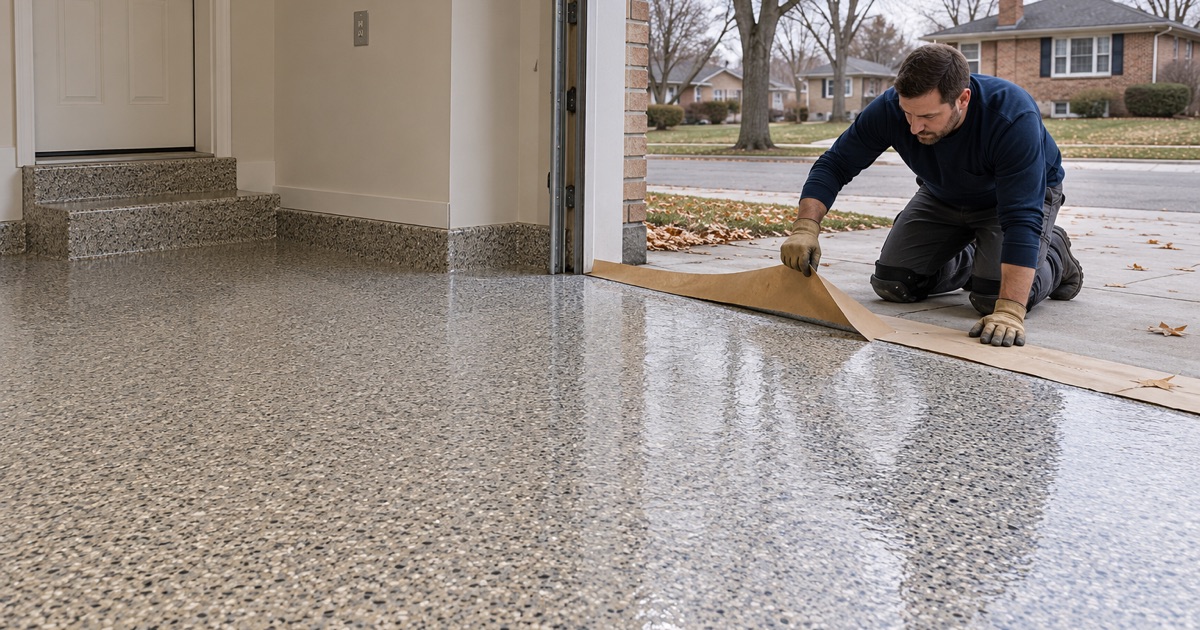
Polyaspartic cures far faster than a conventional epoxy, so a full garage system can often be ground, coated, broadcast and topcoated in a single working day. For a household that needs the garage back quickly, or a business that can only close for a night, that faster return to service is the main reason to choose it.
Fast cure does not mean instant strength, though. The surface may be walkable within hours while the coating is still hardening underneath, so we still give separate walk-on and drive-on times based on the slab temperature during the cure.
UV Stability for Sunlit Floors
Polyaspartic is an aliphatic polyurea, which means it resists the ultraviolet yellowing that standard aromatic epoxies show in sunlight. On a garage floor where the door stays open on summer afternoons, an epoxy topcoat can amber unevenly near the opening, while a polyaspartic top holds its color.
That is why we use polyaspartic topcoats on most floors that see daylight, from garages to sunrooms and covered patios. Even when an epoxy base is used for thickness, a polyaspartic top keeps the color true for years.
Flexibility and Abrasion Resistance
Compared with a rigid epoxy, polyaspartic stays slightly more flexible, which helps it ride through the small seasonal movement in a garage slab without cracking or chipping as readily. It also resists abrasion from grit, tools and tires well, so it keeps its gloss longer in a busy space.
That combination is what makes it a strong wear layer over a vinyl flake broadcast. The flake gives texture and hides dirt, and the polyaspartic topcoat seals the chips in and takes the scuffing that would dull a weaker finish.
Where Polyaspartic Needs Care
Short Working Time
Polyaspartic starts to set quickly after it is mixed, which leaves a short window to spread, back-roll and broadcast it. A crew that mixes too much at once ends up rolling material that is already thickening, leaving lap marks, bubbles and thin spots that show in the finished floor.
We mix in small, measured batches and work the floor in planned sections, with enough hands on site to keep a wet edge. It is slower on paper than mixing everything at once, but it is the difference between a smooth floor and one marked by every pass of the roller.
Bonding to a Ground Slab
Polyaspartic penetrates and bonds best to a slab that has been opened to the right ICRI concrete surface profile with a diamond grinder or a shot blaster. It does not tolerate an acid-etched, sealed or dusty surface, and because it cures so fast, it can lock in a weak bond before anyone notices.
We grind every slab, remove old sealers and coatings, and vacuum the floor clean before the first coat. On many floors we also use a penetrating primer or an epoxy base, so the system has the strongest possible bond to the concrete before the polyaspartic goes on top.
Humidity, Temperature and Dew Point
The cure speed of polyaspartic changes with humidity and temperature. On a humid summer day it can set faster than expected, and on a cool morning near the dew point moisture can condense on the slab and disturb the cure.
We measure slab temperature and dew point spread on the day rather than going by the calendar, and adjust the mix, the batch size or the schedule to match. When conditions are wrong, the job moves, because a rushed polyaspartic floor cannot be fixed without grinding it off.
Polyaspartic Systems We Install
Full Flake Polyaspartic Garage Floors
Our most common garage system uses an epoxy or polyaspartic base coat, a full vinyl flake broadcast and a polyaspartic topcoat. The base builds the bond and thickness, the flake adds texture and hides dirt, and the topcoat seals everything in against salt, sun and tires.
For Glenview garages, where most houses have an attached garage and winter brine rides in on every tire, this system balances speed, durability and appearance. We choose the flake blend and chip size with you from samples laid on your own slab.
Clear Polyaspartic Over Existing Concrete
A clear polyaspartic coat can seal a sound, attractive slab without adding color, keeping the natural look of the concrete while protecting it from stains and salt. It suits garages, patios and workshops where the slab is in good shape and the owner simply wants it easier to clean.
The slab still has to be ground and repaired first, and a clear coat shows every stain and patch underneath, so we walk through what the finished floor will look like before recommending it.
Polyaspartic Over Polished or Decorative Floors
Polyaspartic can also be used as a protective topcoat over metallic epoxy, quartz broadcast or stained concrete. On those floors it adds ultraviolet stability and scratch resistance, so the decorative layer underneath keeps its color and depth.
We match the topcoat sheen to the floor below, from high gloss on a metallic showroom floor to satin on a stained basement, and we add a fine aggregate where wet feet or shoes need extra grip.
Overnight Polyaspartic Floors for Businesses
For a shop, clinic, office or showroom that cannot close for days, polyaspartic lets us grind and coat a section overnight or over a weekend and hand the space back by opening time. We plan the sections around the business, capture grinding dust at the machine and ventilate as we go.
The fast return to service is the reason businesses ask for it, but the same short working time applies, so commercial jobs get the same small batches, section planning and slab testing as a garage floor.
Before a Polyaspartic Floor Goes Down
Moisture Testing the Slab
No coating, polyaspartic included, survives moisture pushing up through a slab. Before we price a polyaspartic floor, we test with an ASTM D4263 plastic sheet test and, where needed, ASTM F1869 calcium chloride or ASTM F2170 relative humidity testing.
Many older attached garages and basements in Glenview were poured without a vapor retarder, so a damp reading is not unusual. When the numbers call for it, we add a moisture-mitigation primer before the polyaspartic system rather than gambling on a dry season.
What the Warranty Leaves Out
Polyaspartic systems usually carry a manufacturer warranty, and nearly every one excludes failures caused by moisture vapor transmission or hydrostatic pressure under the slab. We explain those exclusions before you sign, so the warranty means the same thing on the day of a problem as it did on the day of the sale.
That is also why the moisture test is part of the written scope, and why we will recommend a mitigation primer or a different system when the slab reads damp.
- 20+ Years on Concrete
- Moisture Test in Every Scope
- Free Written Estimates