
Glenview Epoxy Flooring installs epoxy garage floor systems in Glenview, IL, serving surrounding cities including Winnetka, Prospect Heights, Deerfield, Lincolnwood and Norridge. With 20+ years spent grinding and coating concrete, we build garage floors from the slab up: mechanically opened, tested for moisture, repaired, and coated in measured layers that hold up to winter salt and hot tires.
The difference between a garage coating that lasts and one that peels in a year is almost never the color on top. It is how the slab was prepared, whether anyone checked it for moisture, and how thick the finished system really is. Those three things are what we put in writing before the job is scheduled.
Every proposal names the product line, the number of coats and the finished thickness, so you can compare our quote to any other and check the floor against it when we are done. If your slab needs repair or replacement before it should be coated, the proposal says that too.
Preparing the Garage Slab
Diamond Grinding Instead of an Acid Etch
A garage slab is usually hard-troweled, sealed by years of tire traffic and stained with oil, which leaves it too smooth and too contaminated for a coating to bite into. We open it with a vacuum-shrouded diamond grinder to an ICRI concrete surface profile suited to the system, which gives the epoxy a real texture to anchor to.
Acid etching, the method most store-bought kits rely on, only scuffs the very top of the slab and leaves residue behind if it is not neutralized perfectly. Grinding also removes old sealers and paint that an etch cannot touch, so the base coat bonds to clean, sound concrete across the whole floor.
Testing for Moisture Under the Car
Before a garage floor is priced, we test the slab for moisture with a plastic sheet test under ASTM D4263 and, where the job warrants a number, an ASTM F1869 calcium chloride test or ASTM F2170 relative humidity probes. A slab pushing vapor up from below will lift a coating no matter how well it was installed.
In Glenview, the answer often depends on when the garage was poured. Many attached garages from the 1950s through the 1970s sit on slabs with no vapor retarder, while the village’s Ordinance 6589 adopted the 2021 residential code and limited the garage vapor retarder exception to detached garages. A damp reading gets a moisture-mitigation primer instead of a standard one.
Repairing Cracks, Spalls and Salt Pitting
We map every crack, spall and pitted area before grinding, then route and fill cracks, rebuild broken edges with a repair mortar and grind the patches flush. Pitting along the tire paths, the classic mark of years of road salt, is filled so the finished floor reads smooth rather than telegraphing every pockmark through the coating.
Control joints are usually kept open or filled with a flexible material so the slab can still move with the seasons. When a slab has sunk, heaved or broken into loose sections, a coating will only outline the damage, and we will recommend replacement before any epoxy goes down.
Building a Garage Floor System That Lasts
Base Coats in 100% Solids Epoxy
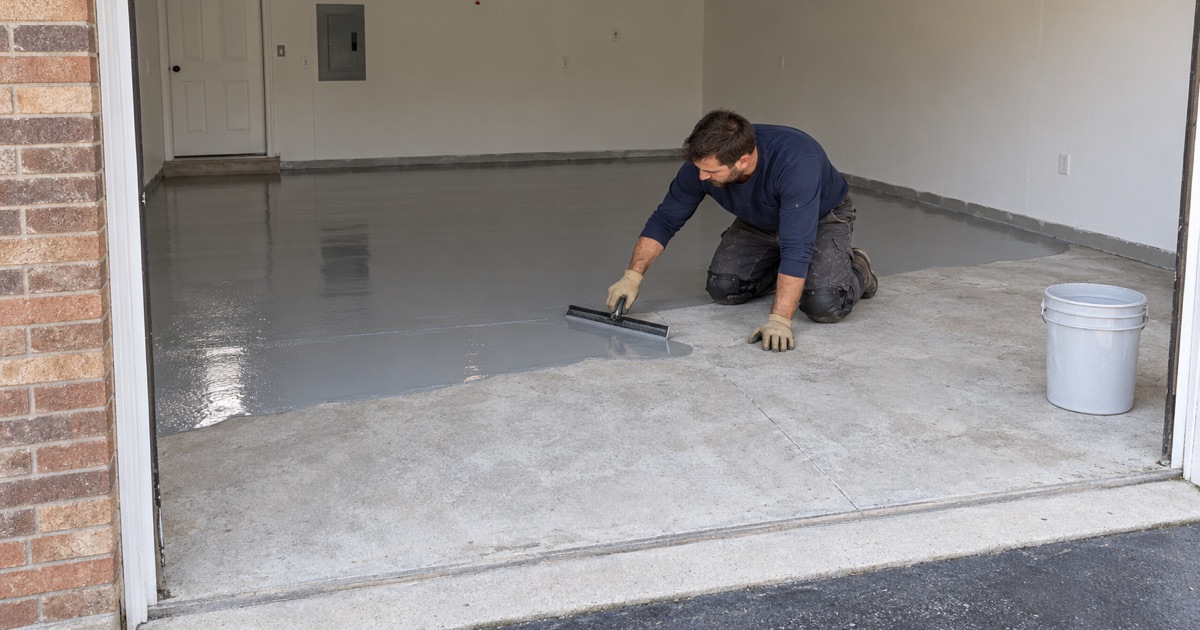
Our base coats are 100% solids epoxy or a polyaspartic base, depending on the system and the cure window. A solids epoxy builds real thickness in a single coat and fills the ground profile, so the finished floor has body instead of a thin film that wears through at the tire paths.
The base coat is where the system gets its bond and its thickness, so we roll it at a measured spread rate and keep the edges, joints and repaired areas wet before the broadcast. That attention at the base is what lets the topcoat do its job of resisting wear rather than holding the floor together.
Full Vinyl Flake Broadcast
Most of our garage floors get a full vinyl flake broadcast thrown into the wet base coat until no resin is left showing. Once cured, the loose chips are scraped and vacuumed, leaving a dense, textured surface in the blend you chose that hides dust, salt residue and tire marks between cleanings.
Flake size and blend change the look as much as the color does. A larger chip reads busier and hides more, while a smaller chip gives a finer, more uniform finish, so we bring samples and show them on your own slab under your garage lighting.
Polyaspartic Topcoats for Sun and Salt
The topcoat seals the flake and takes the abuse, so we usually finish garage floors with a polyaspartic or polyurea topcoat. It resists ultraviolet ambering when the door is left open, stands up to deicer brine, and can be textured for grip where the floor gets wet near the house door.
The topcoat also decides how the floor handles the chemicals that end up in a garage, from gasoline drips to windshield washer fluid and battery acid. We choose one rated for the exposure your garage actually sees, so a spill wipes up rather than leaving a soft spot.
Garage Floors Through a Glenview Winter
Road Salt and Deicer Brine
Calcium chloride and rock salt deicers ride into the garage on every tire for months. On bare concrete the brine soaks in, freezes and thaws, and scales the surface, which is why so many older garage floors are pitted where the cars sit. A sealed coating keeps that brine on the surface, where it squeegees off.
The salt is also why we avoid thin coatings on garage floors. A film that is only a few thousandths of an inch thick wears through at the tire path within a couple of seasons, and once salt reaches the slab beneath it the coating starts to lift from the edges inward.
Hot Tire Pickup
A tire coming off the road is hot and soft, and as it cools on the floor its footprint contracts and grips the coating underneath. On a thin or poorly bonded floor that grip is enough to pull the coating off the slab in tire-shaped patches, a failure called hot tire pickup.
We prevent it the only way that works: a ground slab, a properly thick base coat and a topcoat rated for vehicle traffic. Cheap coatings fail here first, which is why we treat a garage floor as a vehicle surface rather than a painted floor.
Cold Slabs and Cure Schedules
Resin floors need a minimum slab temperature and a slab that stays above the dew point while they cure, or they cure soft, cloudy or with an amine blush on the surface. We measure slab temperature and dew point spread on the day, rather than scheduling by the calendar, and adjust or postpone the job when the numbers say so.
An attached garage that shares heat with the house can often be coated in the colder months. An unheated detached garage in deep winter is told to wait for spring, because a floor rushed into a cold slab is the one that fails first.
Garage Floor Paperwork Done Right
Permits and the Village’s Garage Rules
Glenview’s Development Center lists flooring and painting among work that does not need a permit, so coating an existing garage slab normally does not need one. Replacing the slab does, and goes through the village’s concrete review. The village also requires the door sill between an attached garage and the house to sit at least 4 inches above the garage floor, which we keep in mind when a floor is built up.
Written Contracts and Consumer Rights
Illinois’ Home Repair and Remodeling Act requires a written contract for home repair work over $1,000 and the Home Repair: Know Your Consumer Rights pamphlet before work begins. We provide both before grinding starts, with the product line, coat count and finished thickness spelled out on the contract itself.
- 20+ Years on Concrete
- Moisture Test in Every Scope
- Free Written Estimates