
Glenview Epoxy Flooring installs ESD flooring in Glenview, IL, serving surrounding cities including Winnetka, Prospect Heights, Deerfield, Lincolnwood and Norridge. Static-control floors are some of the most technical systems we put down in our 20+ years of floor work, because the result is measured in ohms rather than judged by eye, and a floor that looks perfect can still fail its first resistance test.
Electrostatic discharge can damage sensitive electronics long before anyone feels a spark. An ESD floor drains static from people, carts and equipment to ground in a controlled way, and it does that only when the slab is prepared, the grounding is laid out correctly and the finished floor is tested and documented against the range your program requires.
Static-Control Flooring Explained
Conductive and Static-Dissipative Ranges
Static-control floors are grouped by their electrical resistance. Under ANSI/ESD STM7.1, a conductive floor measures below 1.0 x 10^6 ohms, and a static-dissipative floor measures at or above 1.0 x 10^6 and below 1.0 x 10^9 ohms. Conductive floors drain charge quickly and suit areas handling explosives or highly sensitive devices, while dissipative floors suit most electronics assembly, labs and server rooms. We confirm the required range with you before choosing the system.
The Person, the Footwear and the Floor
ANSI/ESD S20.20 treats the floor and the person standing on it as one system. Its requirement is that a person wearing approved grounded footwear on the floor cannot generate more than 100 volts. That means the floor, the footwear and the facility’s own grounding all have to work together, and we explain how the floor we install fits the rest of your static-control program.
Coatings Versus Tiles and Mats
Static control can also come from conductive vinyl tile, rubber or floor mats, and each has a place. A seamless ESD epoxy has no joints for dirt or chemicals to collect in, takes carts and rolling racks well, and can be extended or repaired in place. Mats only cover a workstation, and tiles depend on their adhesive and seams staying intact. We help you weigh those trade-offs against how the room is used, how often it is cleaned and how much of the floor really needs protection.
How an ESD Floor Is Built
Slab Preparation and Moisture Testing
An ESD floor starts like any coating, with a slab ground or shot blasted to the right ICRI profile and tested for moisture. Moisture coming up through the slab can cause blistering and can also change the electrical behavior of the system, so testing with ASTM F1869 or ASTM F2170 methods is part of the written scope. Old coatings are removed completely, because an insulating layer under the floor can undermine its performance.
Grounding Strips and Conductive Primer
After priming, copper grounding strips are laid out across the floor and connected to a verified building ground at planned intervals. A conductive primer or base layer goes over them, creating a continuous path for charge to travel to the strips. Getting this layout right is the hidden half of the job, because a gap in the conductive layer or a poorly connected strip leaves dead spots that no topcoat will fix.
Static-Dissipative Epoxy Topcoats
The wearing surface is a static-dissipative epoxy, often with conductive fibers or additives that carry charge down to the primer. It is applied at a controlled thickness, since too thick or too thin a coat can move the floor out of its target range. We finish it in a color that suits the space, often light gray, and add safety striping or zone markings where the layout needs them.
Testing and Documentation
Resistance Testing After Installation
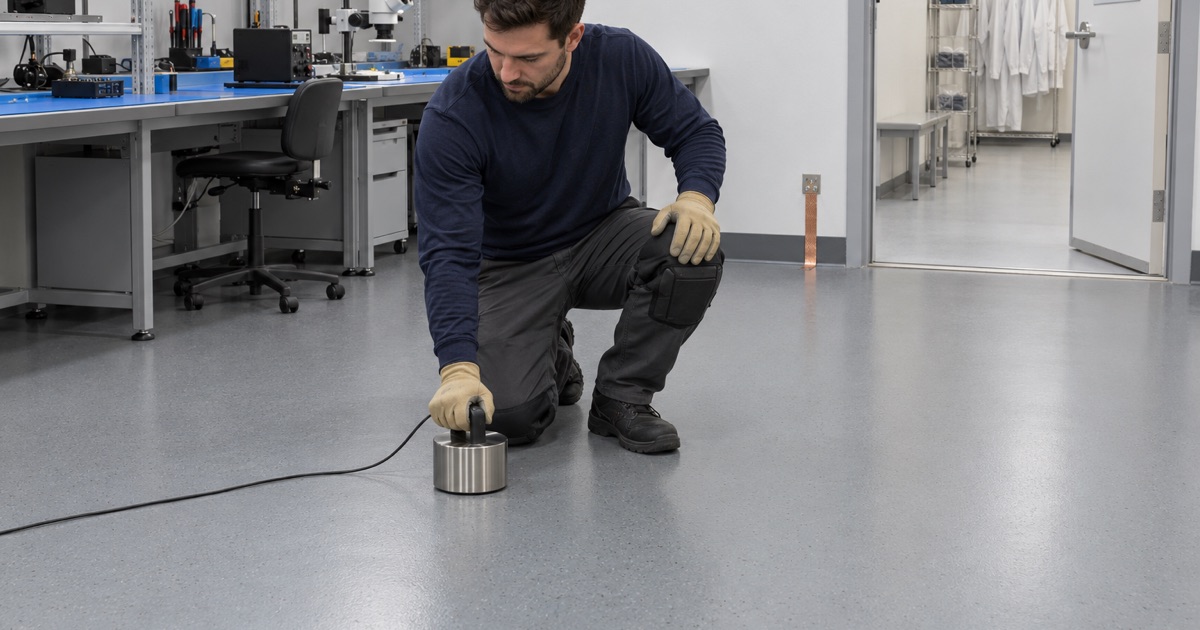
Once the floor has cured, we test it with a calibrated meter, measuring resistance point to ground and point to point at locations spread across the floor. Readings outside the target range are traced and corrected before the floor is handed over. We follow the test method named in your specification or the ESD Association standards your facility audits against.
Records for Audits and Programs
Facilities that follow ANSI/ESD S20.20 need documentation that the floor meets its range. We record every reading with its location and hand the results over with the product data sheets, so your quality team has a baseline. Periodic retesting by your team or ours then shows whether cleaning or wear has changed the floor’s performance.
Where ESD Flooring Is Used
Labs, Research and Electronics Work Areas
Glenview’s corporate and research campuses include laboratory and technical spaces, and anywhere electronic components are assembled, tested or repaired benefits from static control. Electronics workbenches, test labs and clean areas typically use a static-dissipative floor alongside grounded workstations and wrist straps. We coordinate the floor with the furniture and grounding plan so the whole area works as one system.
Server Rooms and Data Closets
Server rooms and data closets hold equipment that can be damaged by static from people walking in and out. A static-dissipative floor reduces the charge carried into the room and makes the space easier to keep dust-free. We schedule these installations around maintenance windows and protect running equipment from grinding dust with containment and vacuum capture at the machine.
Care and Cleaning of ESD Floors
An ESD floor keeps its performance only if it is cleaned correctly. Waxes, floor finishes and many general cleaners leave an insulating film that raises resistance, so the floor should be cleaned with products approved for static-control flooring. We provide cleaning guidance with every ESD floor and recommend periodic resistance checks as part of your static-control program.
- 20+ Years on Concrete
- Moisture Test in Every Scope
- Free Written Estimates